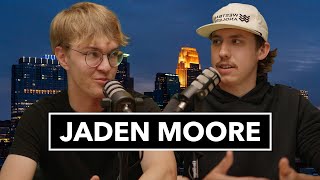
Abby Szlosek was finishing her sophomore year at Clemson University — fresh off a 4.0, days away from a three-week study abroad trip to London, Paris, and Munich — when she sat down for this episode. She made digital content for Clemson Athletics through the Creative Solutions department, took on freelance work on the side, and had been building her creative skillset since she picked up a Nikon D3500 on Facebook Marketplace in February 2020. Isaac met her through Clubhouse, the short-lived audio app that briefly had everyone trying to network in 2021.
Why Abby Szlosek Chose Clemson
Abby came in wanting to be an academic weapon. She applied early decision to Vanderbilt and got rejected. Boston College and Georgetown waitlisted her. Each of those schools was running about $75,000 a year. Clemson, with her in-state scholarship, came out to around $10,000 to $12,000.
“You know what — effort. I had a really good in-state scholarship.”
It was the right call. Clemson had a sports program she wanted to get involved with, and that involvement became the defining part of her college experience. The Creative Solutions department — which produced digital content for Clemson’s athletic programs — turned out to be exactly the environment she needed.
Inside Clemson’s Creative Solutions Department
Creative Solutions operated more like a real job than a typical student org. Abby was a part-time intern with six required office hours a week, plus time shooting games and producing content for lacrosse, football, basketball, soccer, and more. Every full-time staff member was under 30. The culture was collaborative and the mentorship was real.
“I don’t know if I’ll ever have it this good ever again. Like, this is the standard.”
What made it meaningful wasn’t just covering games — it was telling athlete stories. A highlight reel from a soccer game is one thing. Showing who that athlete actually is, what they went through to get there, is something different. Clemson was pushing toward that, and Abby was part of making it happen.
She kept tabs on peers doing similar work at other schools. By most accounts, Clemson was ahead — more resources, more intentional mentorship, and a real commitment to differentiating its content from the rest of college sports media.
How She Got Started: A Tennis Tournament, a Facebook Marketplace Camera, and Bad Timing
It started at a local tennis tournament around 2019. A friend two years older than her showed up with a camera, and something clicked. She followed his Instagram, saw what he was building for his high school, and wanted in.
In February 2020, she found a Nikon D3500 on Facebook Marketplace and bought it. She got in a couple of photo shoots with friends before COVID hit and shut everything down. South Carolina reopened relatively quickly, and by fall she was back — shooting football, soccer, baseball, doing the occasional senior picture.
She brought the camera to Clemson and kept going. By November 2021 she applied for an Athletics internship, got in, and shifted almost entirely to video. By the time of this episode, her split was roughly 90 percent video, 10 percent photo.
“Nobody really sees how much I’m putting into it — unless you’re there working with me personally.”
The Freelance System Running in the Background
On top of Athletics, Abby ran a quiet freelance operation built around sorority recruitment videos. She spent the spring semester attending events every couple of weeks — brunches, spin classes, social events — filming everything and dumping it to a hard drive without editing a frame. Once school ended, she put it all together into the videos sororities used to recruit new members in the fall.
It was a smart system: batch the filming across the semester, batch the editing when school was out. Low friction, steady income, repeatable every year.
Isaac had his own version of that kind of hustle going — local Ames TikToks that didn’t always rack up big numbers but showed up in search when people looked up local spots. A Pepsi deal and a gas station sponsorship came from nothing more than consistent posting and a visible follower count.
“They just saw my follower count and they saw that I’m uploading frequently, even though I get like 200, 300 views a video.”
The takeaway from both sides: visibility doesn’t require virality. Showing up consistently in the right places — even with modest numbers — opens doors that algorithms alone don’t.
On Leaving School and Betting on Yourself
Isaac had left Iowa State before recording this episode. His entrepreneurship class had been taught by a management professor with no entrepreneurship experience. Then the class screened a Casey Neistat video — and from inside a college curriculum, the framing felt wrong to him. Neistat dropped out of high school, had a kid young, slept between cities. The college version of that story wanted it to be inspiration. For Isaac, it landed like a sign.
“From a college perspective, I don’t see why he’s a great guy. From my perspective, I love that guy.”
He touched on a similar thread in the first episode with Will Hearn — the tension between institutional paths and building something on your own terms while everyone around you is still inside the system.
Abby wasn’t ready to skip the degree, and she didn’t need to be. Creative Solutions was giving her real work, real mentorship, and a portfolio she actually cared about. Her plan post-graduation was to join a creative agency or in-house team first — learn how different people work before going independent.
The Coolest Opportunity: Documenting Clemson’s First-Year Lacrosse Team
When Isaac asked what opportunity she was most grateful for, Abby didn’t hesitate.
Clemson had just launched a new Division I lacrosse program, and she got to document its entire first season. The team finished ranked in the top 20. She rode the bus with athletes, got to know them individually, and helped tell the story of a group of people building something from scratch.
“People are gonna look back at that in like 10 years. They’re going to want to watch the videos of when they were winning their first year — and I got to be a part of that.”
She had just finished watching Last Chance U around the same time, which sharpened something she had already been feeling on the sidelines: every athlete has a story worth telling. The highlight is almost beside the point.
Key Takeaways
- The right school isn’t always the prestigious one. Abby passed on waitlist spots at Georgetown and Boston College for an in-state scholarship that let her focus on building real skills instead of managing real debt.
- Batch your freelance work. Filming all semester and editing in one focused push is more efficient than trying to do both at once. Systems beat scattered hustle every time.
- Consistency beats virality for local opportunities. Posting regularly — even to a small audience — puts you in search results and on the radar of brands that want someone reliable, not someone famous.
- The best creative environments feel like real jobs. What made Creative Solutions valuable wasn’t the resume line. It was mentorship from people under 30 who were genuinely invested in what they were building together.
- Every athlete has a story beyond the highlight. The best sports content doesn’t just capture what happened — it captures why it mattered to the person it happened to.
Connect with Abby on LinkedIn or follow her on Instagram. Connect with Isaac at isaacjarnagin.com.