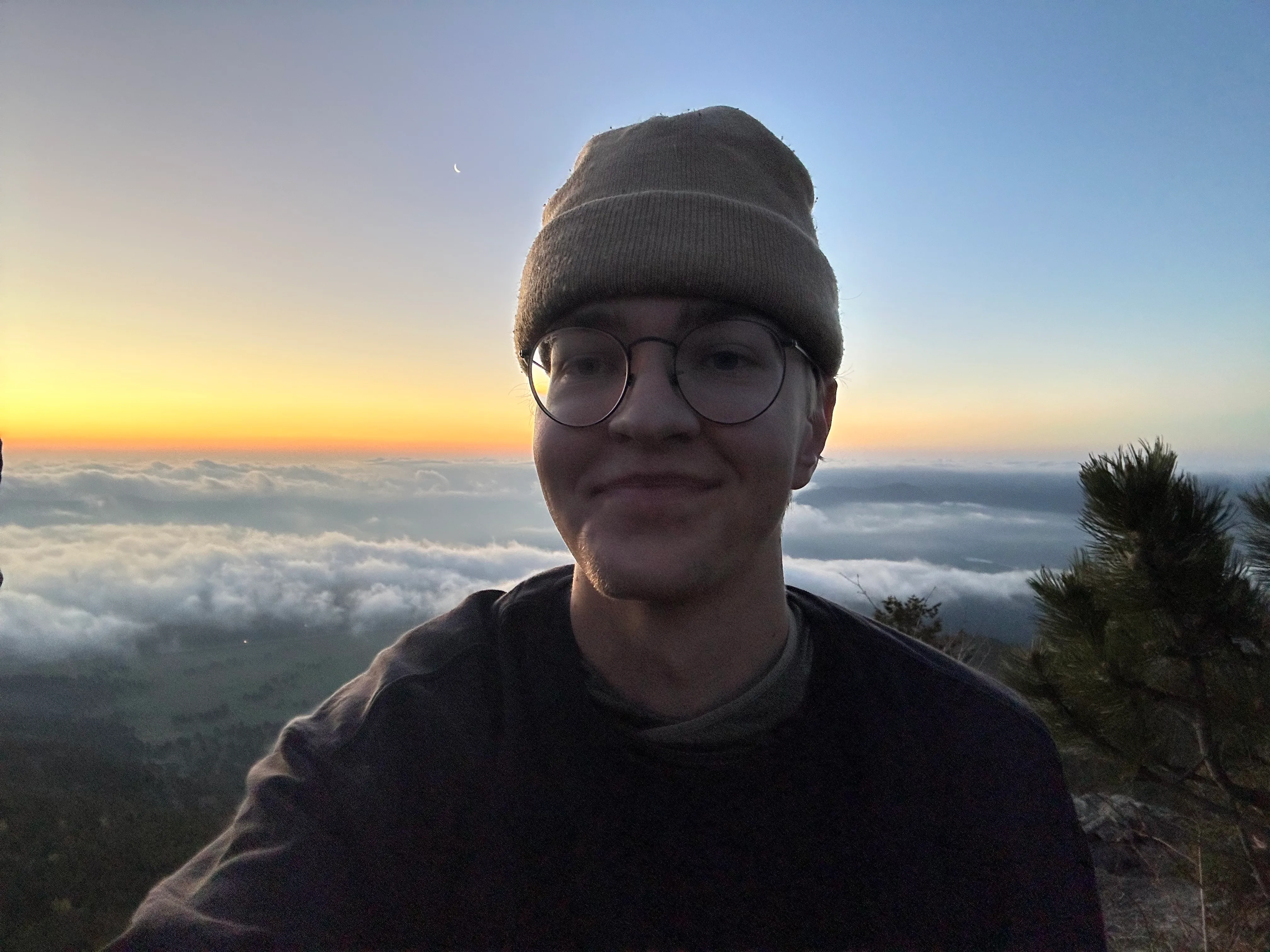
Nathanael Mudlaff is a college student at California Baptist University in Riverside, California, and a childhood family friend of Isaac’s. They’d grown up in the same orbit in Iowa — crossing paths a few times a year, sharing an early interest in creative media and social media before either of them knew what to do with it. The episode covered Nathanael’s transition to California, his first real concert photography shoot through a cold outreach connection he’d been building since high school, the CBU photography program, and how gym habits had quietly restructured the rest of his life.
From Iowa to California
Nathanael’s first year at CBU had a rough stretch — a bad roommate situation that made both semesters uncomfortable in ways he didn’t go into detail on. By sophomore year that had flipped entirely. He was in a new apartment with six friends from his old dorm, double the square footage, in-unit laundry, their own garage and backyard — a hundred dollars more a month than what he’d been paying before.
The broader question of whether California was the right call was more honest. He was direct about the parts that weren’t working: roads, cost of everything, the homelessness problem. But the calculus still came out positive.
“For like four years and getting an education here I think it’s like totally worth it — the experiences are like something that you can’t do at the University of Iowa.”
The people were the part that surprised him most. His closest friends at CBU turned out to be from Colorado, Kansas, Missouri — people with different upbringings who happened to like the same things. That variety felt like something he couldn’t have gotten at a school closer to home.
“The people here are incredibly different — we all like the same things but we’re just so different. Versus when you go home and it’s like everyone’s kind of the same person.”
Long-term, California probably wasn’t the plan after graduation unless something specific locked him in. But for these four years, the call had been right.
How Nathanael Mudlaff Got Into Concert Photography
Near the end of his senior year of high school, Nathanael had been listening to a folk/country artist who turned out to be a student at CBU. He connected, offered to shoot for him, and they went back and forth — a few things got scheduled and fell apart. Then the artist announced a show in Los Angeles.
“I saw he had a concert here in LA, and I was like, ‘Hey, if you need a photographer for the concert, let me know’ — he’s like, ‘Yeah dude, that’d be awesome.’”
It was his first concert shoot. About 300 people in a sold-out lounge-style venue, tight enough that finding angles meant pushing through the crowd. He’d given his ticket to a friend and had them hold a spot near the front so he could move around when he needed it. He’d never shot a live show before — the whole set was spent in motion, figuring it out as the night went on.
“I never shot a concert before so I was kind of just running around — and the photos ended up turning out a lot better than I expected.”
The artist posted them. Nathanael walked away with a portfolio piece and a clear sense of what kind of work he wanted more of. The whole thing had started with a cold outreach message two years earlier — not a pitch, just contact.
“Reaching out is like the number one thing to be successful — you would be surprised how many people reply.”
He’d been doing that for a while: reaching out to artists he loved, not necessarily asking for work, just making the connection. The ones he’d reached out to early, before they were big, had become genuine relationships. Robbie Wheeler talked about a similar approach in episode 14 — cold emails to artists and managers, sent during the quiet stretches, with zero expectation and occasional real results.
CBU’s Photography Program
Nathanael had switched from photo major to minor, but the switch didn’t mean stepping back from the program. The classes were still part of his schedule, and his read on them was straightforward.
The professors had shot for major companies, had real working experience, and were accessible in a way that a large state school wouldn’t allow. At a program this size, the ratio worked in his favor.
“Photography or any sort of media thing is just a world of connection — when you can actually grow a relationship with someone who’s doing this for a living, that’s a connection you can’t just go get.”
The class that surprised him most was the one he’d expected least from: a required intro course on the camera that anyone on campus could take. He’d expected to sit through explanations of ISO and aperture he’d already figured out on his own.
“I learned more in that class than I probably have [in a long time] — such an easy basic course that I would have not taken if I didn’t need it. How much it benefited me is just ridiculous.”
He came in not knowing the difference between RAW and JPEG. A year later he barely recognized his own old work — not because anything was ruined, but because the gap between then and now was that wide.
Social Media, Fumbled Audiences, and the Long Game
Both Isaac and Nathanael had real TikTok followings when they were younger, and neither of them had known what to do with it. Isaac had been making tech content; Nathanael had been all over the place — trampoline, random stuff, egg videos at the Iowa State Fair that got enough traction that people still called him “egg boy.” He’d tried to go back to the fair last year for a sequel run, showed up too late, and the eggs were already gone.
“Me and you both can fall asleep knowing we fumbled the bag with our audiences at that early of an age.”
The common thread: you don’t know your interests at that age. Scattered output across too many different things means followers who showed up for one thing leave when you post something else. The lesson came the slow way, but it landed.
On the business side, things had started to click. Isaac had three consistent clients — a friend doing Amazon work, a tree service, and a real estate agent — plus a one-off bank shoot that came through after months of cold emails with zero responses.
“I sent a lot of cold emails earlier this year — I got zero responses — but in the last month I had the bank reach out and be like, ‘Hey, I saw your email, you want to come and record something?’ I’m like, yeah, one of my emails worked.”
One worked. That’s enough.
The Gym, Film, and Building Better Habits
Nathanael had been six days a week in the gym since the previous November. He’d started around 125 pounds standing six feet tall — he and Isaac had both been in that range — and was sitting at close to 160 by the time of this recording, still working on the bulk.
“It’s like a lifestyle change — it’s not like I’m going to get big or whatever, it’s like, you’re going to go to the gym every day. That’s just how it’s going to be.”
What he kept coming back to wasn’t the physical progress. It was the routine. Once the gym is a fixed anchor in the day, everything else organizes around it — meals, sleep, schedule, the order of tasks. Removing the decision removes the negotiation.
“The gym and nutrition gave me the discipline and the confidence to take on all these other things.”
On the film side, he’d started shooting on his mom’s old camera — his first roll not yet fully used up, with a trip to Laguna Beach and Newport coming up to finish it out. CBU’s program let him develop film for free through the school, which had removed the only real barrier to getting started.
“I never understood it until you’re actually shooting it — it’s like a whole different thing. It puts you in a bubble and makes you think about your shots more.”
The slowing-down is the point. Every frame costs something, and knowing that changes how you look at what’s in front of you.
Key Takeaways
- Start the conversation before you need anything from it. Nathanael had been reaching out to artists for years — not asking for work, just making contact. The concert shoot came from a message he sent two years earlier.
- Small programs give you access big ones don’t. The ratio of students to professors at CBU meant real relationships with people who’d actually worked in the industry — and that’s worth more than any YouTube tutorial.
- You don’t know your niche at 15. Both Isaac and Nathanael had real followings they scattered across too many directions. The lesson about consistency came the slow way — but it came.
- Cold email has a long lag time. Months of zero responses, then one yes. The pipeline has to stay open even when nothing comes back.
- The gym builds the scaffolding everything else runs on. Six days a week creates a rhythm that organizes meals, sleep, and work schedule without having to decide about any of them individually.
- Film slows you down in exactly the right way. When every frame costs something, you look harder at what’s actually in front of you before you press the shutter.
Follow Nathanael on Instagram. Connect with Isaac at isaacjarnagin.com.