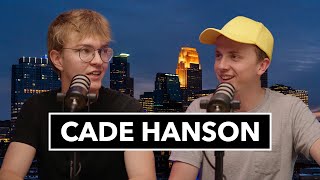
Sam Musgraves was a Michigan-raised media production student at the University of Cincinnati and sports videographer who got his start filming high school football after years of pointing a camera at himself doing gymnastics and break dancing. Isaac had followed his work for a while without ever talking, and the episode covered how a camera purchase junior year of high school became a college internship by day two of freshman year, what Sam actually thought about Road mics and external monitors, the wedding photographer who ran the day like a military operation, and what the summer ahead looked like.
How Sam Musgraves Got Behind the Camera
Before he had a real camera, Sam was filming himself. He was into gymnastics and break dancing as a kid, and the way he captured it was by pointing whatever he had at himself and cutting it together — early on with VidLab, an editing app that predated most of what people use now.
Junior year of high school, he decided to actually invest. He bought his first real camera, and almost immediately the question followed: what else could he film?
“What if I just film the football game tomorrow.”
He did. The response was immediate.
“Feedback was crazy — everyone was loving it, everyone was reposting it.”
He kept going — football first, then other high school sports. By the time he got to college, he had real work to show and a sense of what he was doing with it.
Landing the Cincy Internship
Sam got to the University of Cincinnati and found his way into the athletics media program on his second day of school. It didn’t take a campaign — it took a hallway conversation.
During icebreakers in one of his classes, a classmate introduced himself as a sports creative. Sam found him after class, showed him his footage, and the classmate brought it straight to the person running the program.
“He showed it to the boss and the boss was like hey you’re on — I’m like sweet.”
He was one of three video people in the program at the time. A few years in, he was part of one of the program’s best stretches: the 2021 Bearcats season, when Cincinnati went undefeated and became the first non-Power Five school to make the College Football Playoff. The team played Alabama in Dallas. The student interns didn’t get credentials to shoot — but they were there.
“Got to go to Dallas for the game to watch us get blown out by Alabama.”
The paid interns had the sideline. The student section still had the game, and a good night after.
Chasing Credentials and Building a Name
One consistent thread in Sam’s approach was going after events he wasn’t officially connected to. The method was simple: reach out, explain what you shoot with, offer to color and label footage within a set window, and see what happens.
“I’ll just like reach out to them, tell them what I shoot with, tell them I’ll color it, label it within this amount of time after the game, love to help you guys out — and it’s like half and half.”
Smaller schools were more likely to give him a shot. Bigger programs already had enough people making the trip. He took a swing at a Michigan hockey game in Ann Arbor — Michigan vs. Notre Dame in the Big Ten tournament — and got nothing back. Still worth trying.
That same early-hustle energy was something Sam saw in jdopefx, a creator who started recording for his local high school and had since worked his way up to the Olympics and NBC. Sam mentioned Isaac was set to talk to him the following day.
Beyond credentials, Sam had his eye on the Cincinnati Cyclones — the city’s ECHL minor league hockey team — as a near-term opportunity. He’d looked at their social media and noticed an obvious gap: photography was there, video was barely present.
“I think I could be a valuable asset.”
Hot Takes on Gear and Ego
Isaac asked Sam for hot takes, and he had a few ready.
The Road mic on a camera rig was the clearest one. Sam didn’t see the point.
“I just can’t stand the people with like the shitty Road mic on their camera rig.”
His argument: most cameras pick up audio well enough on their own, and in fast-paced sports and event work, he’d never actually noticed the external mic making a meaningful difference in the final cut.
“I’ll see their video and I don’t hear the nat sound or anything — so what was the point of it?”
External monitors were a more evolved take. He used to think they were unnecessary — his old Sony a6400 had a flip screen and he could see what he was getting. But the Sony A7S3 he’d upgraded to had a screen that folded sideways rather than forward, which made checking framing on vertical content awkward. He’d come around on monitors. He’d been wrong.
The ego piece ran deeper than gear.
“When you get something good, that should be a propeller to put more good in the world rather than to like be like y’all I’m cool.”
He wasn’t interested in gear tribalism or tearing down other creators. The work was hard, putting anything out was worth acknowledging, and using a good gig as a reason to look down on others was the wrong use of the moment.
Josh Horton was someone Sam had known since high school — a Michigan guy who’d later moved to Grand Rapids and collaborated with Sam on a video, quietly taking over the lighthouse visual effects work and executing it completely. That kind of creative generosity was the opposite of ego.
First Wedding and the Summer Ahead
A few months before they recorded, Sam had filmed his first wedding. The bride was his cousin, which meant the personal stakes were high and the pressure was real.
What stayed with him most wasn’t the filming — it was watching the wedding photographer run the day.
“She was like military — she was like yeah, no no here, walk now, look, no, kiss at him.”
She directed the whole thing with zero hesitation, always a step ahead of what needed to happen next. Sam talked to her afterward. She was doing about 20 weddings a year as her only work, charging around $5,000 per event. It reframed what that kind of career could look like.
For the summer, a few directions were in play. A minor league baseball internship had fallen through — the team said the spot was filled, which surprised him. That left real estate as the most likely path: an old client had gotten into real estate and was in talks with Sam about filming properties over the break. Less creative range, clean compositions, good money. Brian Pollari had talked about building a whole media company around that kind of work — Sam was approaching it as a summer bridge.
He also had footage sitting on a hard drive he wanted to cut before college basketball fully wrapped. And Blender was on the list — the learning project he kept putting off.
“I’m trying to make it like a resolution of mine this summer.”
The longer arc was consistent: get a role at a college program, move to the pros eventually, build his own media company from there. No rigid timeline on how to get there.
“As long as I’m doing video, I’m happy.”
Key Takeaways
- Start with what’s in front of you. Sam filmed his high school football team because he had a camera and the game was happening. That’s the whole origin story.
- Your work travels faster than your outreach. Getting into Cincy’s media program took a hallway conversation, not a campaign — because the footage could speak on its own.
- Chase credentials even with bad odds. Half the time you get in. The other half, you still made the ask and built the habit.
- Ego is the wrong use of a good gig. When you land something, the right move is to put more into the world — not to use it to look down on others.
- Watch high-level operators whenever you can. The wedding photographer directing the day on military precision was a masterclass Sam didn’t expect to get at a family wedding.
- Know which gaps you can fill. Scanning the Cyclones’ social and noticing their video was missing isn’t just observation — it’s how you get in the door.
Follow Sam on Instagram. Connect with Isaac at isaacjarnagin.com.