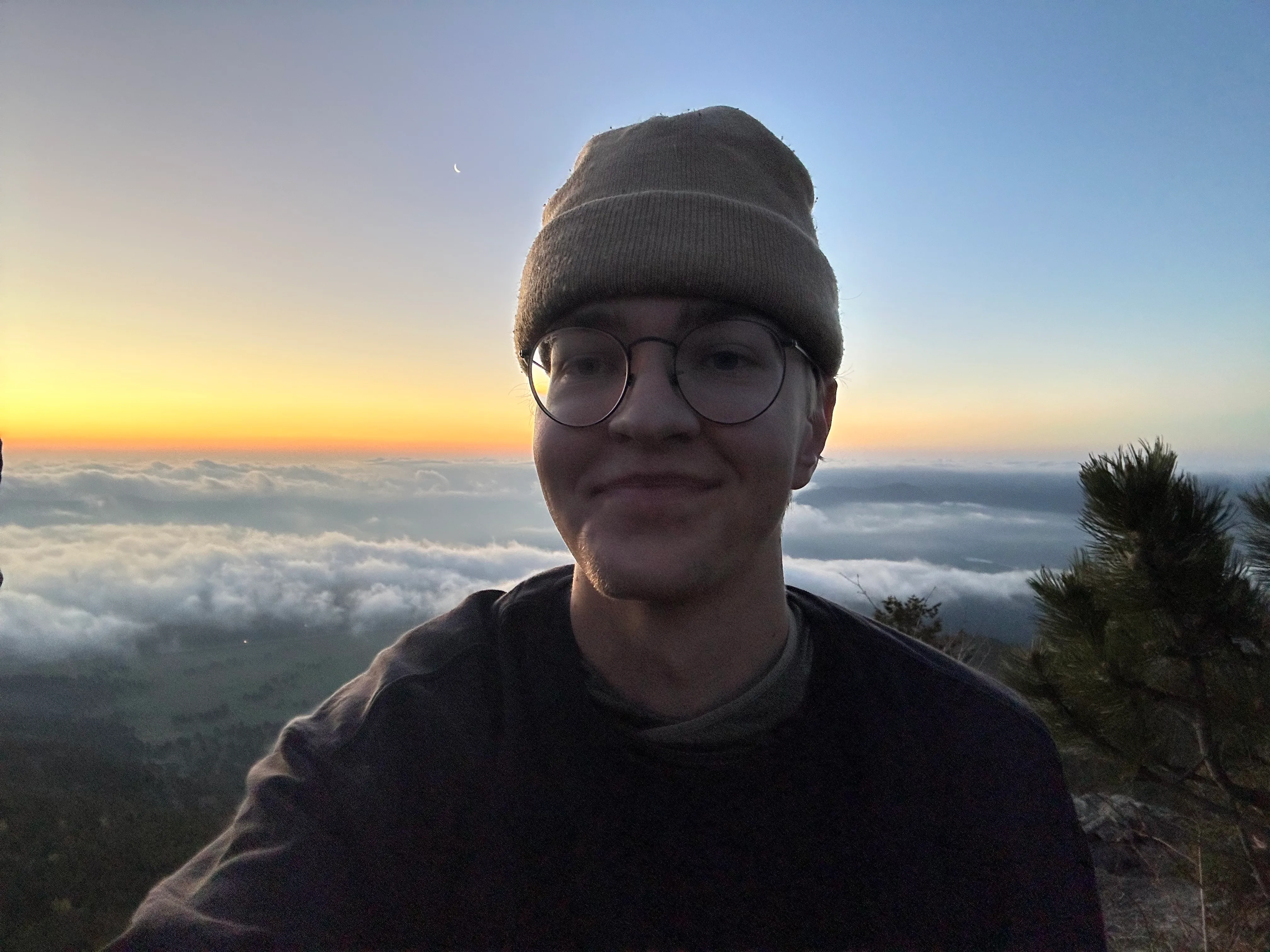
Cade Hanson is a videographer and digital marketer based in Colorado who packed up everything, moved to a city where he barely knew anyone, and spent the first six months working 117-hour weeks to build a client base from nothing. Isaac connected with Cade through mutual friends — including Henry Smisek from episode 6 and Vlad from episode 2 — and this one turned into something closer to a masterclass than a podcast. They cover what “turnkey digital marketing” actually means, why local businesses chasing 10K followers are wasting their time, and how a woman running 200-mile races gave Cade the clearest framework he has for his entire approach to business.
From iMovies to Film School: Cade Hanson’s Origin Story
Cade’s path into video started in elementary school, where he discovered he had a talent for making what he calls “banger iMovies.” Any time there was an option to do a video instead of a paper, he was doing a video — and by middle school he was putting 20 to 30 hours into school projects that his teachers expected him to spend an hour on.
That obsession grew through high school, where he started shooting for his school’s sports and events and managing their social media. He put all his landscaping money — earned since age 12 — into camera equipment and online courses. By the time he got to film school in California, he already had a working business. He wasn’t starting from zero like most of his classmates.
“I saw the people show up to film school not knowing anything and thinking they were gonna come out on the other end as professionals. You have to put in the time and all of the hours of just doing dumb things and making mistakes before thinking about making money.”
The film industry was exciting at 20. But he knew he couldn’t be wrapping sets at 4 a.m. indefinitely if he ever wanted work-life balance or mountains over smog. So he moved back to Colorado — the second time he’d been there — and started over from scratch. No clients. Almost no network. A one-year time horizon and a decision to grind.
What Turnkey Digital Marketing Actually Means
Most videographers hand a client a finished video and call it a day. Cade’s model is different. He calls it “turnkey digital marketing” — and it’s the thing that separates him in a room full of freelancers delivering the same type of content.
The idea: a cool video is useless if a business doesn’t know how to implement it. So instead of just delivering deliverables, Cade builds the entire system around them — the automations, the sales funnels, the customer journey from social media to website to booking to Google review. He hands businesses a working machine, not just a piece of it.
“I know I can walk into any Chamber of Commerce or any networking meeting and have a product that I can sell to about 75 percent of the people there because it’s a solution, not just a cool thing.”
The insight that unlocked this came from listening. He stopped trying to pitch what he did and started listening to what clients actually complained about. Businesses weren’t struggling to find good-looking video — they were struggling to turn it into anything. The real pain point wasn’t the creative. It was the implementation. Once he heard that consistently enough, he built a product around solving it.
Surface Area of Luck: Networking as a Business Strategy
When Cade moved to Colorado with no clients and no network, social media wasn’t going to save him. He needed to meet people. So he started showing up to Chamber of Commerce meetings and local networking events in Evergreen, Colorado. For the first three or four months, nobody wanted to talk to him.
“After they saw me show up for four months in a row to every single event they went — oh, this isn’t a fly-by-night type of guy.”
Now those same people text him memes and invite him to their family events. The selling took care of itself once the relationships were real.
His framework for why this works is what he calls the “surface area of luck.” If 500 to 1,000 people know you, you’re regularly in contact with 100 of them, and you’re actively talking to 50 — statistically, someone in that network needs what you do every single month. It’s not luck in the lottery sense. It’s math plus presence.
“The more you can increase that surface area of luck — meaning there’s more people added to your network at A, B, and C grades — you are going to have work.”
This reframes how he thinks about social media for local businesses too. The goal isn’t 10,000 followers. A local business with 10,000 followers probably has 9,000 from across the country who will never spend a dollar with them. What matters is 1,000 local, qualified followers who see you in their feed every week. You meet them in person first, you give them a follow, and social media does the work of staying front of mind.
“If you have a thousand followers as a local business, that’s all you need — if those are good followers.”
What Ultra Marathons Taught Cade About Running a Business
Before this episode, Cade had just come back from volunteering at a 100-mile ultra marathon in Colorado. He’d also run a 70-miler himself — on four weeks of training. A few years into ultra running, he’s found that almost everything that makes someone finish a 100-mile race is the same thing that makes someone build a sustainable business.
The three words he keeps coming back to: patient, present, and deliberate.
“Business, especially as a freelancer, it’s not a sprint. It is a very long-term thing that you have to stay patient, present, and deliberate in everything that you do.”
During one of his own 50-mile races, he was falling behind on cutoffs and spiraling. Then he spotted a woman ahead of him who’d done 200-mile races. Her splits were within a minute of each other, lap after lap — total control. He made a decision: just follow her heels for the last 26 miles. Don’t look at the clock, don’t think about the finish line. Just make it to the next aid station.
“If I just look at her heels the whole time for the last 26 miles I will cross the finish line — and that was everything.”
The bigger lesson from watching her: she was only focused on inputs. Hydration locked in, nutrition locked in, foot care managed early, pace controlled. While everyone around her was burning out by chasing their split times, she was working her way from the back of the pack to the front — steadily, almost exactly on the schedule she’d predicted. She never once talked about running. She only talked about the inputs.
Input Goals vs. Output Goals
That same philosophy runs directly into how Cade sets goals for his business. He doesn’t set revenue targets. He sets input goals.
“When it comes to goal setting, I much prefer to set input goals versus output goals. Somebody will set a goal of I want to make 10 grand this month. It’s a different goal that I’m going to reach out to 100 people this month. You can control all the inputs.”
Revenue for the month isn’t something you can will into existence when you’re two weeks behind. But you can always control whether you go to a networking event twice a week. You can control how many follow-up emails you send. Those are the goals that actually move a business forward — because the only reason you’d miss them is if you chose not to do them.
It works in racing too. In his last 50-miler, when the cutoffs started looking impossible, he simplified the goal: just keep moving for 18 hours. That’s controllable. Whether he made the cutoffs was an output. The 18 hours, he could own.
Stacking Skills and Knowing When to Work for Someone Else
One of the more honest stretches of this conversation is Cade talking about the freelancing vs. employment question. He used to be a freelancing absolutist — convinced it was the right move for everyone. He’s not anymore.
“I’ve helped a lot of people get into freelancing and I’ve helped a lot of people get out of freelancing and every situation is different.”
His updated view: if you’re working at Subway and want to do creative work, yes, quit and start shooting. But if you’re at a functioning business — even something unrelated to your field — you’re getting an intimate look at how a business actually operates. That knowledge pays dividends in ways that are hard to quantify when you’re early.
The bigger principle underneath it is stacking skills in the right order. Learn the craft before you learn the pitch. Learn the pitch before you learn the system. Don’t try to jump to the top.
“You have to stack them and not jump to the top — because you might learn branding and then it just falls to the bottom, and you still don’t have a business if it’s not built on knowing the creative side pretty well.”
The time horizon question is really the whole answer. Give yourself ten years to build a six-figure freelance business and it stops being a question of if and starts being a question of when. Extend it far enough and the only way to lose is to stop.
Key Takeaways
- Turnkey beats deliverables. Businesses don’t struggle to find good video — they struggle to implement it. Build the system around the content and you become a solution, not a vendor.
- Surface area of luck is real. The more people who know you — and the more consistently you show up for them — the more predictably work flows in. It’s not luck. It’s math.
- Local businesses need local followers. A thousand real, local followers beat ten thousand global ones every time. In-person networking activates the social audience; social media keeps you in front of it.
- Input goals over output goals. You can’t will revenue into existence, but you can control how many meetings you book and how many people you reach out to. Set the goals you can actually own.
- Patient, present, deliberate. The ultra marathon mindset applies directly to building a freelance business. Control the inputs, extend the time horizon, and the finish line takes care of itself.
- Stack skills from the bottom up. Learn the craft before you learn the pitch, and the pitch before you learn the system. Jump to the top and nothing holds.
Follow Cade at linkedin.com/in/cade-hanson-104bb01b3. Connect with Isaac at isaacjarnagin.com or on Instagram.