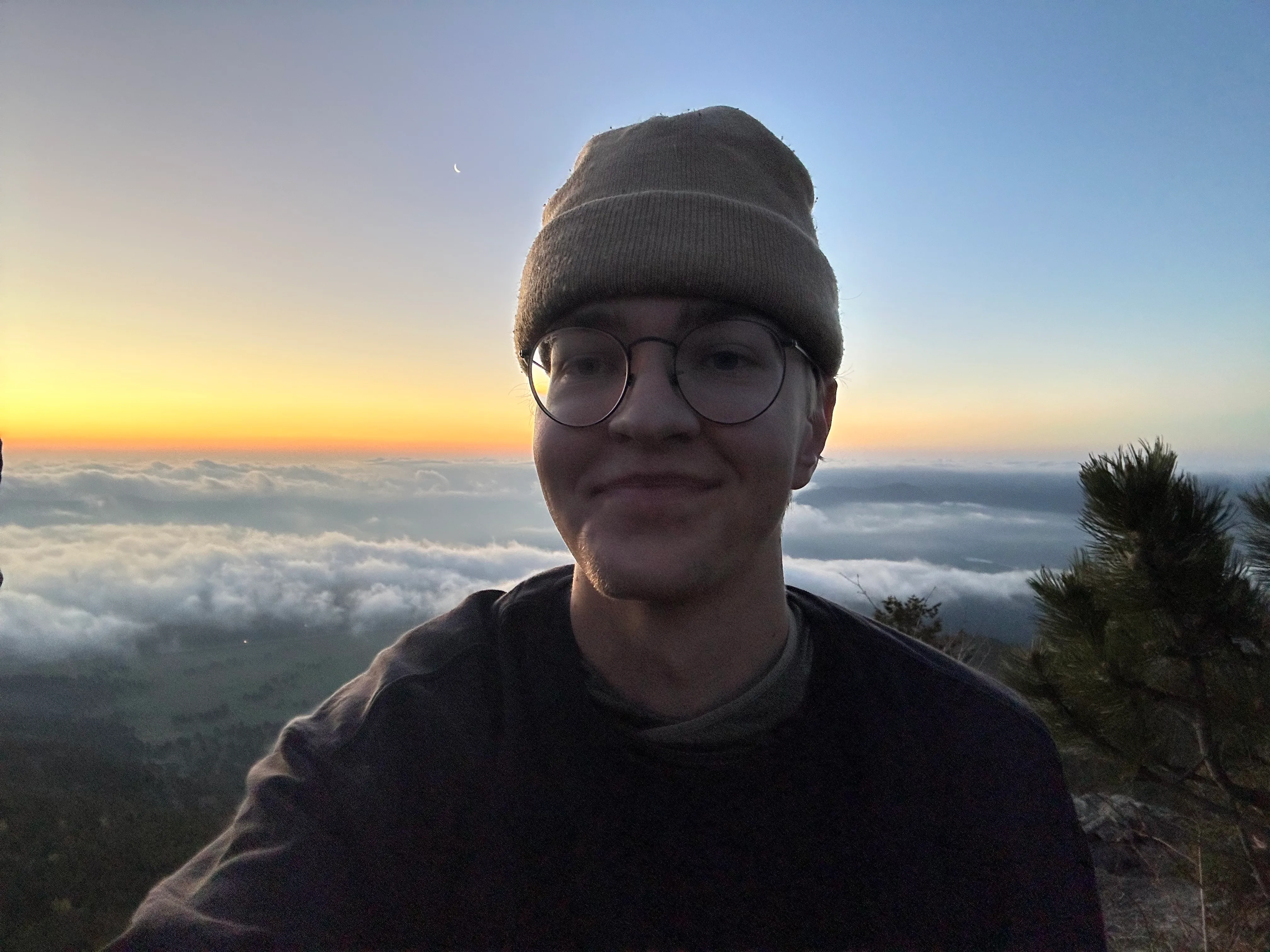
Gavin Britton was a senior at the University of Portland studying marketing, a landscape photographer whose work Isaac had been following for years, and one of the more quietly accomplished creators in his orbit. He was interning at an accounting firm, shooting home games for the university athletics department, running multimedia for the school’s student newspaper, and still finding time to perfect landscapes that stopped people mid-scroll — all at once. The episode covered how a borrowed camera and a grandfather’s encouragement started everything, what it’s like to run two completely different editing workflows simultaneously, why overexposing became his signature, and the Switzerland trip he was boarding a plane for just days after they recorded.
How Gavin Britton Found the Camera
It started with a borrowed camera on a church mission trip. Gavin’s family was involved in mission work — his mom had ties to the Peace Corps and loved traveling — and when his church organized a trip abroad, they lent him a camera to bring. He came back and showed his grandfather the photos.
His grandfather had done photography as a full-time business and recognized something in what Gavin had shot.
“I showed my grandpa who — he did photography for full-time business — and I showed him and he was the one saying like, oh, you should like invest in a camera, like you have something special.”
That was the start. He took a couple of photography classes in high school that he said weren’t very in-depth — the kind that cover exposure triangles and call it a day — and mostly taught himself the rest. The traveling habit was already there: his family did trips instead of gifts, which meant by the time he had a camera worth using, he’d already been to Italy and had a sense of what the world looked like at its best.
Life at University of Portland
By his senior year, Gavin had built out a full creative role across three different campus programs. He was the multimedia editor for the school’s student newspaper — coordinating staff photographers, helping shape story pitches, and producing video content alongside one other videographer on staff. He was shooting home games for the athletics department across multiple sports. And he was contributing to the school yearbook, something he’d done in high school and applied for again when he found out the university still had one.
The athletics workflow was the most structured. He’d submit his availability at the start of each month, get assigned to whatever home games fell on those days, and show up 35 to 40 minutes early for pregame content.
“Basically what that looks like is you go to the game 35, 40 minutes early, get some like pregame — them warming up — you know, then they do like a little pregame post whether it’s a reel or like a story or an actual feed post.”
Edits went straight into a team group chat with whoever was running the school’s social accounts that day. The whole operation ran on iPads with Lightroom Mobile — quick selects, quick exports, content live before the final whistle.
The yearbook had been a surprise find. College yearbooks aren’t as common as they used to be, but the University of Portland’s program was still running and open to new ideas. A spread dedicated to students with interesting cars — reach out, shoot, feature — was one of the pages making it into that year’s edition.
Press Passes and MLS Soccer
Soccer ran through everything. Gavin had grown up playing it, his dad had played in college at a Division II program before a knee injury cut it short, and his whole family had held Seattle Sounders season tickets since the team entered the MLS. He’d met Clint Dempsey at a season ticket holder event when he was younger. By college, that background had turned into a credential — press passes for Seattle and Portland MLS matches, shooting from the sideline next to players he’d watched since he was a kid.
“I love soccer — that’s what I grew up playing. I’m not, I wouldn’t say I’m as good as the people on the field, so it’s just cool to like watch them because I know what’s happening. It’s just like cool to see.”
Isaac said he couldn’t understand soccer’s critics in America. Gavin agreed.
“It’s literally like an art form — there’s just so many aspects of it. It’s really fun to watch. I don’t know where all the negative talk comes from.”
The Landscape Workflow: Curves, Color, and Overexposing
Gavin’s landscape work had a specific look — vivid, full-color, noticeably bright — and he’d spent real time thinking about why.
Most of it came down to curves and intention around exposure. He worked through nearly every setting in Lightroom, spending deliberate time on the individual color curves for midtones, shadows, and highlights, and using radio and graduated filters for shots taken in flat midday light. Photoshop came in only when something needed to be removed from the frame — a stray person, a distracting element — never for color.
“The only thing I really use Photoshop for is if there’s anything distracting — like if there’s a person in it that I just don’t want in it. But I don’t really use Photoshop for like coloring because I feel like it looks a lot different than what I saw.”
The overexposing tendency had crystallized during a trip to Iceland the year before. He was shooting at blue hour, trying to get a bright scene, and kept lowering his shutter speed while a friend standing nearby was underexposing and planning to pull the shadows up in post. Gavin’s take was simple.
“I just kind of like see what looks good — I don’t mean like it’s just all white, but it’s just like maybe one or two stops above what your little camera meter says.”
He was straightforward about it being a style choice, not a technical argument. He’d tried monochrome work and respected it, but rich, layered color was where his eye kept landing.
Fast Editing vs. Slow Editing
The contrast between his landscape workflow and his sports workflow had taught him something that transferred off-camera too.
Sports edits happened on an iPad, under time pressure, during the game. Landscapes happened at a desktop, sometimes months after the shoot — he mentioned having photos from March he was still working through at the time of recording. The sports work had made him faster and forced a kind of decisiveness that his default approach didn’t naturally demand.
“Sometimes the pressure makes you pick like the best and then you’re happy with it. I overthink a lot about stuff, and having to be under the pressure, go go go — I just don’t have time to think about it. I’m just like, oh, I like this one the best.”
Isaac said the same pattern had worked its way into how he moved through everyday decisions. Make the call and move on.
For Gavin, landscapes were still where his instincts were most at home — and the goal wasn’t always the technically perfect image.
“I think my favorite thing is taking the photo. I want to capture the memory.”
He’d been following a photographer who led every carousel with a striking landscape but used the rest of the slides to build the story around it — setup, people, before and after. That approach had started shaping how Gavin planned his own shoots.
Film, the Switzerland Documentary, and What’s Next
Gavin had gotten into film through a trade — a piece of camera gear he wasn’t using anymore swapped for a friend’s Nikon film camera. He shot a few rolls, broke it, and replaced it with the same model off eBay for around fifty dollars.
Nathanael Mudlaff from episode 17 had been getting into film around the same time and described the same effect: when every frame costs something, you slow down and look harder before pressing the shutter. Gavin put it the same way.
“It has helped me kind of be more present when I am taking photos and kind of just appreciate the moment. Take less. I used to take so many photos — I still do — but I definitely take considerably less photos now.”
The Switzerland trip had been in the works for a while. He was going with two friends from the University of Portland — all three of them into photography — renting a car, landing in Geneva, chasing fall colors through the Alps. He wanted to use it as a test run for a longer documentary-style video, something more substantial than a short reel.
“I want to make something longer that I would actually want to show someone — not just like here’s a six-second song-compilation clip thing.”
Isaac made the case for why it mattered: a documentary makes you care about people you’d otherwise scroll past. The clip gets you the hit. The documentary gets you the connection.
After graduation, Gavin planned to keep photography running alongside whatever marketing role came next — freelance work on the side to fund the trips and gear, flexibility to keep shooting on his own terms.
Key Takeaways
- The first camera doesn’t have to be yours. A borrowed camera on a church trip started everything — what matters is showing someone who can see what you’re doing with it.
- Running two workflows builds skills that transfer. Rapid sports edits trained Gavin’s eye to make faster decisions, and that decisiveness carried into his landscape work and beyond.
- Overexposing is a choice, not a mistake. When the photos you like most are consistently brighter than what the meter says, that’s your style showing up — own it.
- Story beats spectacle. The photographers who stuck with Gavin weren’t just showing the landscape — they were building a sequence that pulled you in and kept you there.
- Film slows you down in exactly the right way. Paying per frame forces you to look harder before pressing the shutter. Fewer shots, more intentional ones.
- Keep the creative work funded. Freelance photography as a side income keeps the passion projects alive without betting everything on an unpredictable market.
Visit Gavin’s website at gavinbritton.photography. Connect with Isaac at isaacjarnagin.com.