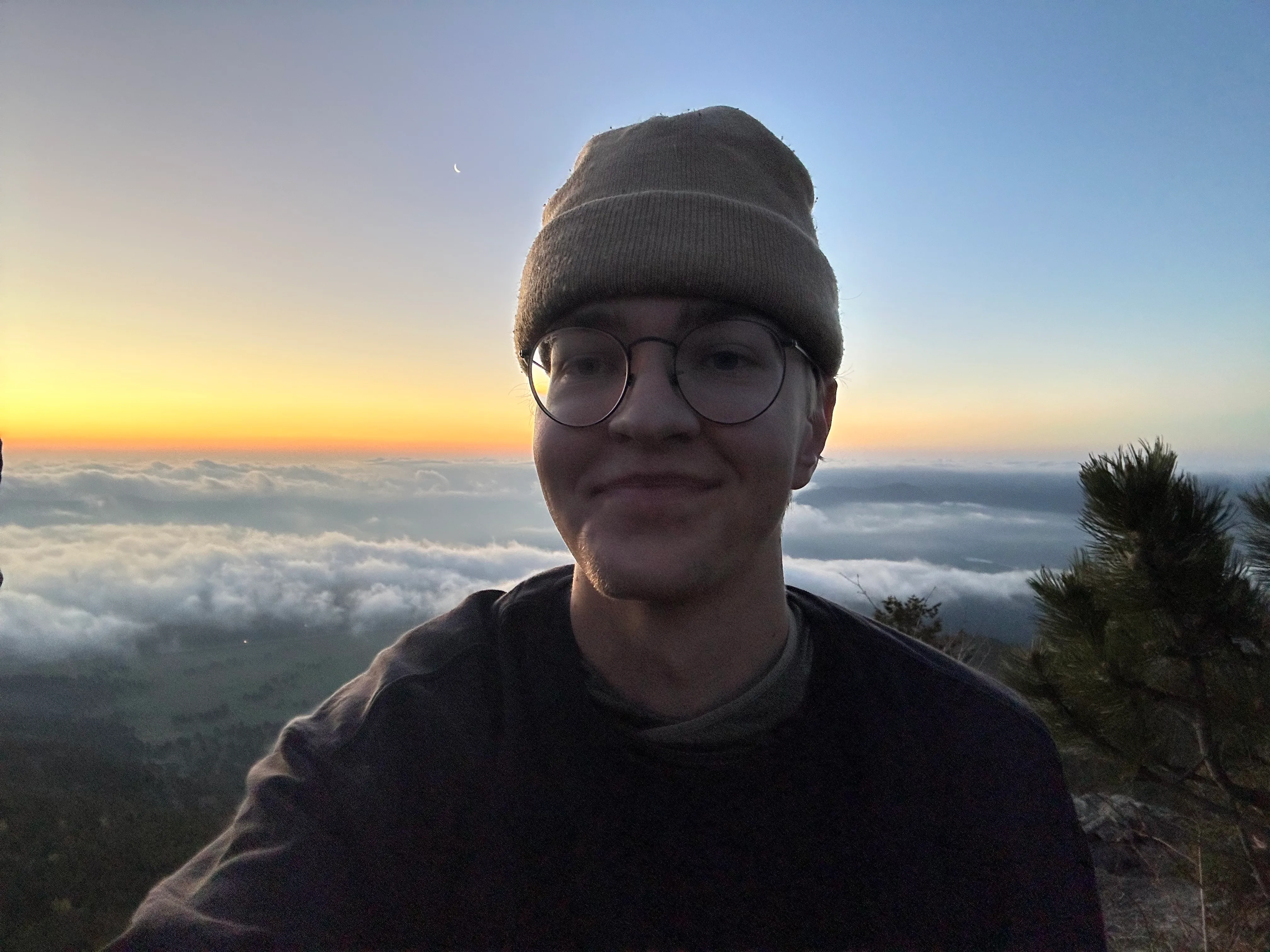
Chris Timothy was a Virginia-based landscape photographer, JMU junior majoring in geography, and Tamron brand ambassador who had spent the week before recording driving 11 hours to Vermont’s Northeast Kingdom to shoot the 2024 solar eclipse. Isaac had connected with Chris through the JMU creative orbit he shared with Austin Sugerman and Jack Windeler, and the episode opened exactly where Chris’s head still was — riding the high of watching totality clear from a snow-covered field in the Northeast Kingdom.
Chasing Totality: The Vermont Eclipse Trip
The plan going into the eclipse wasn’t Vermont. From Virginia, the closest path of totality ran through Ohio and Niagara Falls, and that’s where Chris had been looking. But as the date got closer, he started pulling cloud data directly from NOAA — no middleman, straight from the source — and the forecasts kept shifting. High-altitude clouds were threatening the most critical moments. With totality not returning to the US for another 20 years, he decided it was worth driving as far as he needed to.
Vermont’s Northeast Kingdom turned out to be the clearest window in the entire Northeast — which almost nobody had predicted. It was also a striking place to arrive: they’d just taken a two-foot nor’easter, the roads were still blanketed in snow as temperatures started lifting. Not how most people first see Vermont, but it worked.
He shot with his Sony a7 III and a 150-500mm lens, using a 16-stop ND filter through every phase leading up to totality. He’d also borrowed a second camera from JMU for a timelapse attempt, which ended up not cooperating. Just as totality hit, the clouds started moving in — and the stress that had been building over hours spiked hard before dissolving immediately when they cleared in time.
“I always take a lot of time to just enjoy the moment — it was definitely like there’s nothing else like experiencing totality. I’d say that of anything I’ve experienced.”
The shots turned out. One was already up. He was still working on a second edit — something that played with the geometry of the sequence rather than just presenting a single frame.
How Chris Timothy Got Started
Chris picked up his first real DSLR in 2019 with no clear plan attached. His mom had friends in the Alps she wanted to visit, and he went along. He came back with shots he’d still be happy to take today, and more importantly, he came back with a reason to keep going. Photography became how he documented the places he cared about — a visual journal for someone who’d never really taken to writing.
“Photography kind of became my photographic journal — I just don’t write very much about myself, as much as I want to. So photography kind of captured that.”
The learning was self-directed and YouTube-driven, the same path most of his generation took for skills that weren’t being taught anywhere formal. By the time he got to JMU, he had enough of a portfolio to land two photography-related campus jobs: one shooting and writing for the geography department’s annual magazine, and a second as the university’s photography and videography intern, building stock campus content for the school’s promotional channels and social media.
“It’s cool to see your work get out there — when people at your school repost it you’re like, oh, that’s kind of cool.”
The Tamron Story
The Tamron ambassador relationship didn’t start with a pitch. It started with years of tagging.
Chris had been shooting with Tamron lenses throughout his early work and including the brand in his posts — not as a strategy exactly, more because it felt natural to say what he was shooting with. Over enough posts, enough of which were getting better, Tamron noticed the progression and reached out.
“After enough of those they just were like — we can see the progression of the work — and then they just basically invited me to be their brand ambassador.”
The first major deliverable was a written feature: they commissioned photos, ran an interview about his compositions and the stories behind them, and paid him for the piece. Then last summer came a bigger ask — 15 reels, his first serious push into video. Austin Sugerman was instrumental in helping him figure out that format. The reels went up on Tamron’s page. He hadn’t heard back from them recently when they recorded, but the eclipse trip had given him new material — a natural reason to reach back out.
Editing Philosophy: Why Lightroom Is Enough
The workflow has simplified over time. It used to involve more steps — additional plugins and tools layered on top of the base Lightroom edit. Now it’s just Lightroom for the full edit, and Photoshop for dust spots or anything that distracts from the composition. That’s it.
Part of what pushed him toward restraint was what Ben Skaar had said on his episode: that he edits based on how a place made him feel, not how the place actually looked. Chris could see the logic in that framing. He had older images that leaned harder into the processing, and they felt like a different era — not always bad, but clearly separable from his actual experience of being somewhere.
“I’m more satisfied with my own work when it’s just Lightroom, honestly — because everything you do is in there. And to someone who’s also in photography, knowing that’s a credible thing.”
There’s also a practical reason for keeping it natural: if you save your RAWs and stay close to real, you can go back to any image and still appreciate it. Isaac had learned the same lesson the harder way — a stretch of not saving RAWs left him with a hard drive full of heavily stylized files he didn’t want to revisit.
2020, Clubhouse, and the Road Trip
The 2020 Clubhouse era landed at what felt like peak Instagram for photography. Photography-focused rooms were running constantly, and the combination of direct critique from photographers he’d followed for years and the resulting algorithm engagement made it one of the most productive periods for his work. The right person engaging with a recent post would light up the explore page. It was a specific window that felt genuinely different from what came before and after.
It was also where Chris connected with the JMU creative crowd — Video Adventure Club, Austin and Jack — which eventually led to a three-week, 7,000-mile road trip across the country.
The standout from that trip, looking back, was Wind River in Wyoming. Remote enough that it felt more like Alaska than anything in the continental US. A glacial river running through it, no familiar reference points for miles.
But the shot that still doesn’t feel real was the elk at the Grand Teton area. They’d been on a trail at sunset and didn’t make it back in time for the light. On the way out, an elk appeared behind the tree line and started walking toward the road. They waited.
“Just walking around the road in the exact spot — like in the composition I’d been envisioning. Settings were already locked in. Super lucky. Got one of the best shots I’ve ever taken.”
He’d looked back at that image and genuinely thought: if someone else had posted it, he might have assumed it was composited.
What’s Next
The summer after recording had a few things lined up. Study abroad in Malta from May through June, with a free weekend that might turn into a trip to Greece. A Nature Conservancy internship to follow — land management, working outside, hopefully building connections that could extend past the summer.
The geography degree was running two tracks at once: an environmental concentration pointed toward conservation and land management work, and a GIS concentration that opened into urban planning, cartography, and drone-based geomapping. The geomapping angle had already produced a real gig — a wind turbine placement company found him via Google search, hired him to take georeferenced photos at a series of locations for their modeling software, and had the results plugged in within ten minutes of him sending the files. Zero creativity involved, completely different from anything he’d done before, and still interesting in its own way.
“Having both those together could be really helpful — and then combining photography into it.”
He’d also just launched a personal website on Squarespace about two weeks before they recorded. The hardest part wasn’t building it — the software was simple. It was going back through years of unorganized files and realizing how much had been lost or degraded. Some of his earlier work only existed in lower-resolution versions now. He used them anyway. The site was already doing its job: the wind turbine company found him through a straight Google search. No outreach, no campaign. Just presence.
Key Takeaways
- Go to the primary source for conditions data. NOAA beat every third-party weather app for eclipse planning — going direct gave Chris the edge to chase clear skies when others stayed put.
- Consistent tagging is slow-burn outreach. The Tamron deal didn’t come from a pitch. It came from years of posting work and crediting what he shot with.
- Lightroom restraint is its own form of craft. Keeping the edit in Lightroom — and only Lightroom — is something other photographers recognize as a deliberate choice, not a limitation.
- Save your RAWs. Both Chris and Isaac learned this the expensive way. Without the raw file, you can’t revisit an image with fresh eyes years later.
- Let the moment find you. The best shot of the road trip came from waiting on an elk that walked into a composition Chris had already visualized — patience over forcing it.
- Presence beats outreach. A website two weeks old and a consistent posting habit brought in a geomapping client through a Google search. When the infrastructure is in place, it works while you’re not watching.
Visit Chris’s work at christimothy.com. Connect with Isaac at isaacjarnagin.com.