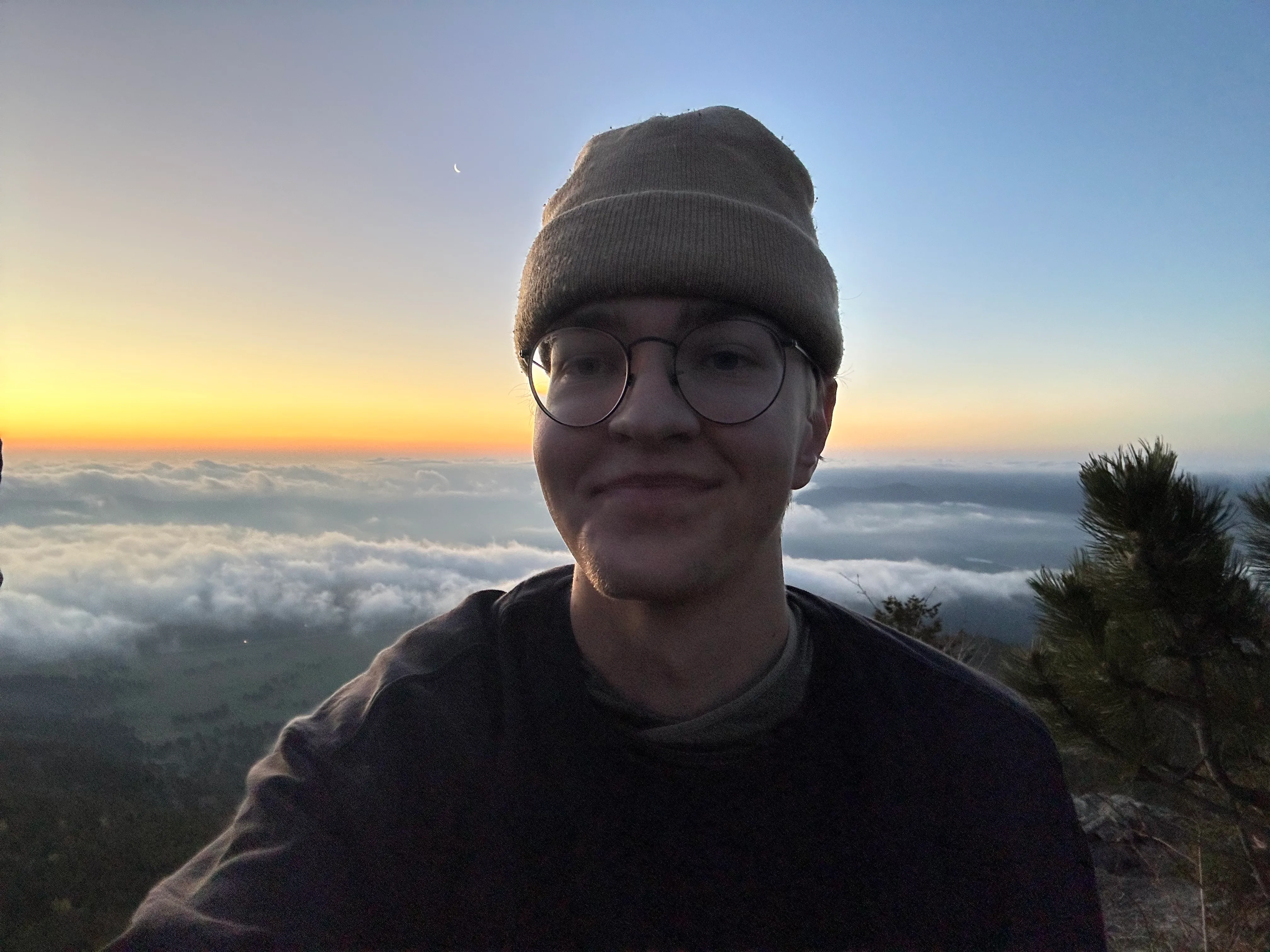
Jack Windeler was a film student at James Madison University in Virginia, the co-founder of Ambient Media alongside Austin Sugerman from episode 15, and someone who arrived at college three years deep into filming and found himself waiting for the rest of the class to catch up. He and Isaac talked about the gap between film school expectations and reality, how spending eight months grinding through Blender tutorials eventually killed his laptop, what running a video business with a creative partner actually looks like from the inside, and a 7,000-mile road trip that ended with a 42-hour straight drive from Canada back to Georgia.
JMU, the Film Program, and Finding Austin Sugerman
Jack had three years of filming under his belt before he stepped into his first college film class, which made the experience of sitting through beginner-level instruction feel like a mismatch from the start.
“I get into school and I’m expecting to kind of get information and knowledge at the level that I was at — and it’s not like that. You get there and the people you’re going with haven’t picked up a camera before. It’s like, what is this? I’m paying 40,000 a year to be taught at a beginner state.”
But the real value of school wasn’t in the classroom — it was in the clubs. He found the Video Adventure Club’s Instagram page near the end of his freshman year and saw Austin Sugerman from episode 15 running it. Austin had started the club specifically to find serious video people on campus.
“I found the Instagram page and he was running it — I was like, yo, this looks sick, get me in this.”
They met at the beginning of sophomore year and recognized each other immediately as the two strongest cinematographers at the school. Ambient Media followed naturally — they started the business in January of that sophomore year, having already worked together for five or six months before making it official. The thing that made it work was finding someone who matched his energy and his ambition, and not having to carry the whole operation alone.
“A big problem that I had was trying to do everything on my own. So it was refreshing to find somebody who matched that energy that I could work on the business with.”
Ambient Media and Making Real Client Impact
The business had been growing through connections Austin sourced, with Jack handling more of the editing and filming in the early going. A mountain biking and ski resort became one of their bigger clients — six videos for their social channels — and the feedback from that project stuck.
“He said when they posted the video we did promoting their lessons, the next day there were already six lessons booked. To see that tangible result of our video impacting the business like that — that was a really cool moment.”
Jack was candid about the learning curve on the business side. He’d arrived thinking the creative work was the hard part. Contracts, proposals, pitching ideas — the mechanics of actually running a company — were a different kind of challenge that he and Austin were figuring out as they went.
“At the beginning you just do the fun gigs and then all of a sudden somebody pays you $60 — they’re like, oh, you do this for me. But now it’s like you’ve got to have contracts, you’ve got to have proposals, you’ve got to do all these things.”
For now it was still the two of them — adding people to a team takes real management capacity, and they weren’t there yet. But the direction was clear: eventually let others handle the business operations while they focused on filming.
How Jack Windeler Got Into Blender
The jump from photo and video to 3D animation wasn’t a deliberate plan — it was a curiosity he couldn’t quite explain, followed by a grind he could.
He started learning Blender his freshman year of college. The first eight months were rough — YouTube tutorials every day, barely able to do anything without looking something up, a 2017 MacBook Pro rendering scenes overnight until it finally gave out entirely.
“That first eight months was just treacherous. Like you’re going into something every day that you can’t do anything without a tutorial.”
He learned primarily through YouTube and recommended Ducky 3D as the best starting point for beginners. The momentum eventually shifted from following tutorials to bringing his own ideas to life — building shapes, constructing materials, working toward animations he’d conceived himself.
“The idea that you could think of anything and be able to animate it — I thought that was just the coolest thing ever. So yeah, I think that’s why I had the motivation in the beginning.”
One of the things Blender taught him that carried over into his live-action work was composition. Building a 3D scene from scratch forces you to think about every element of the frame — the lighting, the materials, the camera angle — in a way that filming in the real world sometimes lets you skip. That thinking sharpened.
“If you truly understand composition, you can test that by trying to composite something in Blender, because you have to do everything. So if it looks good when you built it from the ground up, that gives you the understanding.”
By the time of recording he’d been pulling back from Blender, finding himself more drawn to traveling with a camera than sitting at a computer. But the foundation remained.
The Blackmagic and Gear Philosophy
Jack’s first video camera was a Blackmagic Pocket Cinema 4K — not the cheapest entry point, but a deliberate one. He’d been watching other filmmakers shoot on Blackmagics and wanted what that camera could do. He bought it and had been using it ever since. At the time of recording it was five years old and still his main camera.
His editing philosophy had converged on Final Cut Pro — fast, reliable on Mac, and cleaner for how he worked than Premiere. He’d tried After Effects many times and it had never clicked. Over time he landed on something he kept coming back to: if effects weren’t adding to the story, they were pulling attention away from it.
“I’ve really tried to get into the effects sector and it’s just failed. If it’s not adding to the story it’s distracting from the video — it’s not as professional, it’s not as clean, it’s not as message-driven.”
That thinking had been reinforced by watching great photographers work. Isaac referenced Gavin Britton from episode 19 as an example of someone who goes deep in Lightroom and produces work that shows it — and the principle translated directly to video. Jack’s own take:
“My perspective on video is every frame of the video should be a picture — or like should be able to be a picture. Like if you were to stop at every frame and see it, it should look perfect, it should look well-designed.”
On gear more broadly, he’d been intentional. He spent money on a gimbal when he needed the movement capability. He bought a shotgun mic he quickly realized he didn’t understand well enough to use properly — the one purchase he’d take back. His three lenses, the camera, and the gimbal were his whole setup.
“I’ve never bought a piece of gear that I still don’t use. So I haven’t overbought things.”
He pushed back on the idea that gear didn’t matter, but was equally clear about the ceiling on what new equipment actually changes.
“Gear does matter to a certain extent. You just need that 4K, something that looks good to you, something that has potential for the long run. And if I had a Red right now, there’s no reason for me to have a Red.”
The Road Trip and What Comes Next
The road trip had come up because Isaac had seen it on social media — 7,000 miles starting in Georgia, through Colorado, Wyoming, Montana, up into Canada, and back. Jack and his friend Ethan did the whole thing together. The drive back from Canada to Georgia was completed in 42 hours straight on a bet.
“That feeling of driving from Georgia to Colorado and getting into Colorado and being like, damn, bro, we drove here — that was like the craziest start to that.”
Of everything they saw, Colorado stood out above everything else. The mountains, the people, the energy. Jack said he was considering driving straight out there after graduation and building something from there.
The trip had also created an unexpected creative thread with Isaac. Austin had made a 40-minute documentary of the road trip, and the thumbnail was modeled directly after Isaac’s “Overnight Drive to Wyoming” film — a thumbnail of Isaac with his arms around his friends. The two of them had never met before the podcast, but the work had been passing between them.
“We never met before but we’re inspiring the heck out of each other — and we’re basically — dude, that’s the beauty of the internet. The fact that we’re just doing this right now is just so cool. We’ve just never been able to do stuff like this in human history.”
Post-graduation, the plan was to live out of his car — something Jack had been talking about since middle school. He’d since recalculated that a van wasn’t necessary; a car might be enough.
“Even if it lasts a week, if it lasts three months, if it lasts a year — I don’t care. I just want to do it and see where it goes.”
Austin was graduating that year, and the plan was to keep building Ambient Media together from wherever the road took them.
Key Takeaways
- Film school’s value isn’t always the curriculum. Jack got the most out of JMU through clubs and the connections he made, not the classes — which is where he found his business partner.
- Blender rewards obsessive learning. The first eight months were purely tutorial-driven and punishing. The payoff came when his own ideas started to feel achievable.
- Understanding composition transfers across mediums. Building 3D scenes from scratch forced Jack to think about every element of a frame, and that thinking carried directly back into his live-action work.
- Max out your skills on your current gear. He’s been using the same camera for five years and can still feel it hasn’t hit its ceiling. New gear can wait until the current tool is fully understood.
- Keep the team tight. Adding people to a creative business takes real management capacity. Jack and Austin stayed lean on purpose while they got the work dialed in first.
- The creative internet is small in the best way. Austin’s road trip documentary thumbnail was inspired by Isaac’s film and they’d never met. Online creative circles generate real influence between people who’ve never shaken hands.
Follow Jack on Instagram. Connect with Isaac at isaacjarnagin.com.